Metamorphosis
Standing before the works of Yuri Elperin, one feels as though standing amid a relic constructed jointly by history and time, culture and spirit. The layers of paper, wood, metal, fabric, and pigment are not merely a convergence of materials, but a condensation of memory and history. His art releases form from the constraints of the material world, transforming it into a manifestation of spiritual resonance. As the philosopher Hans-Georg Gadamer observed, human understanding itself is a historical mode of existence. Therefore, an artwork does not passively present the past; it continually generates new meaning within the process of Wirkungsgeschichte—the “effective history” through which understanding unfolds. Elperin’s creative practice embodies this very process: an existential experience articulated through matter as language and time as medium.
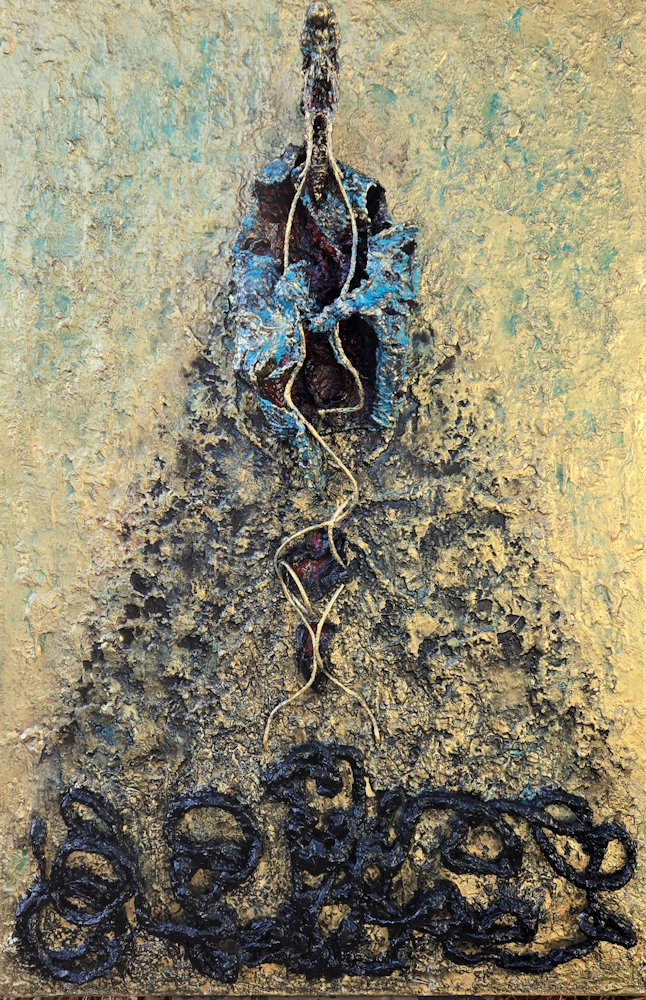

Reincarnation Begins
The Historicity of Artistic Formation
Understanding is historical; every interpretation of art is rooted in preconceptions and tradition. Elperin’s artistic trajectory concretizes this insight. Born in postwar Latvia, he grew up in a world torn apart by war and ideology. The artistic languages he absorbed combined the rigorous structure of the Soviet academic school with the spiritual rebellion of the underground abstract movement. When he left his homeland in pursuit of creative freedom—first to Europe and later to Canada—his horizon was continually reshaped; each migration became a new pre-understanding of the world.
This fluid experience lends his works a tactile sense of history: the oxidation of metal, the cracks in wood, the burn marks on paper—all serve as the grammar of time. In works such as Metamorphosis and Phase One, what we encounter is not mere formal experimentation but the sedimentation of time. They resemble geological strata compressed by the weight of centuries, revealing the artist’s meditation on existence and renewal. Here, the historicity of understanding becomes a historicity of form: form is no longer an external ornament but the visible manifestation of lived history. The artist’s understanding is never detached from history; it is shaped by it. Thus, Elperin’s art becomes a visual consciousness of history—an ontological poetics materialized through matter.a
Wu Zetian Dream
From Personal Memory to the Spirit of Humanity
Understanding always unfolds within the chain of historical effects; our perspectives are already shaped by history. Elperin’s art continues this dynamic of historical influence. In his work, art is not merely an expression of personal emotion but a vessel for the spiritual memory of humanity. Many of his pieces draw upon religious and mythological imagery—The Eye of Buddha, Wu Zetian’s Dream, The Transmigration of the Dragon, and The Beginning of the Endless Knot. These works do not simply retell tradition; they allow tradition to speak anew within contemporary cultural contexts.
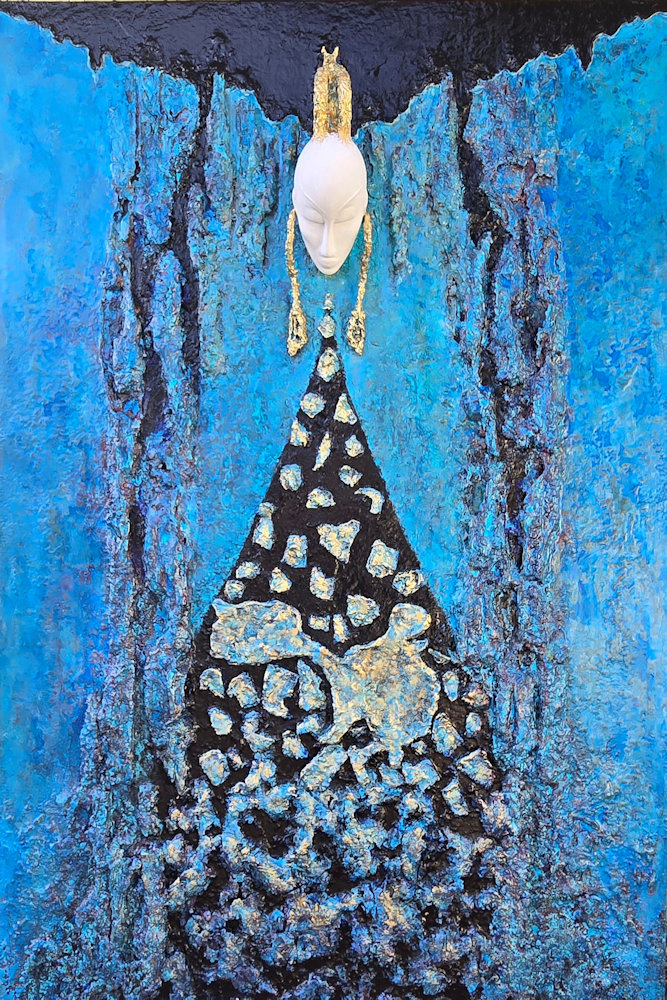
Buddha Eye
This process of “speaking anew” is the concrete manifestation of effective history within art. The meaning of a work is never fixed; it is continuously rewritten through the viewer’s perception and the transformation of cultural context. When facing The Eye of Buddha with its silent gaze, or Something Is Nothing and Nothing Is Something with its paradoxical structure, the understanding that occurs is not a restoration of the artist’s intention but a new historical encounter. Both artist and viewer exist within the continuum of history, together forming the work’s living history. Elperin’s art, therefore, is not a nostalgic return to history but a way of letting history remain effective—a spiritual manifestation propelled by time itself.
Something is Nothing and Nothing is Something
Fusion of Horizons and Cross-Cultural Imagery
Elperin combines Eastern spirituality with Western modernist experimentation, allowing different civilizational symbols to meet and generate new meanings. The Eastern notion of cyclical existence—birth and extinction, emptiness and form, the visible and the invisible—intertwines with the Western pursuit of formal freedom and material deconstruction, fusing ultimately into a single vision.
Water Element
In his Five Elements series, metal, wood, water, fire, and earth cease to be mere natural symbols; they become artistic metaphors of cosmic order. The hardness and luster of metal suggest the endurance of form; the texture and vitality of wood express growth; the interplay of water and fire evokes tension and regeneration; and the heaviness of earth anchors the composition with ontological gravity. This reconfiguration of the Five Elements is a fusion of horizons between cultural perspectives. In viewing these works, one perceives not only the meeting of cultures but also the emergence of meaning itself—a visual enactment of hermeneutic fusion.
In Elperin’s art, this fusion operates not only at the thematic level but also through material processes. Metal welding, wooden collage, photographic fragments, and layered pigments are woven together so that the medium itself becomes a metaphor for cultural dialogue. Understanding, therefore, is not the restoration of the past but the creation of new meaning through the encounter of horizons. Elperin’s art comes alive precisely in this act of generation.
Impermanence
Understanding as Existence: Metaphysical Transcendence
Elperin’s works never remain at the level of representation or symbol; rather, they reveal the ontology of understanding through the existence of art itself. In his recent series—Cycle of Existence, Elements of Infinity, and Impermanence—form’s emergence and dissolution, light and darkness, matter and void interweave to create a metaphysical experience. Viewing becomes not a passive cognition but an act of participation in being.
The viewer, facing the work, is drawn into a silent dialogue—not with the artist, but with existence itself. Each act of seeing becomes an event of understanding, and this understanding is not external to us but constitutive of our being. Through this, Elperin completes a passage from the material world to the spiritual: art ceases to be an image about the world and becomes the world’s own manifestation.